
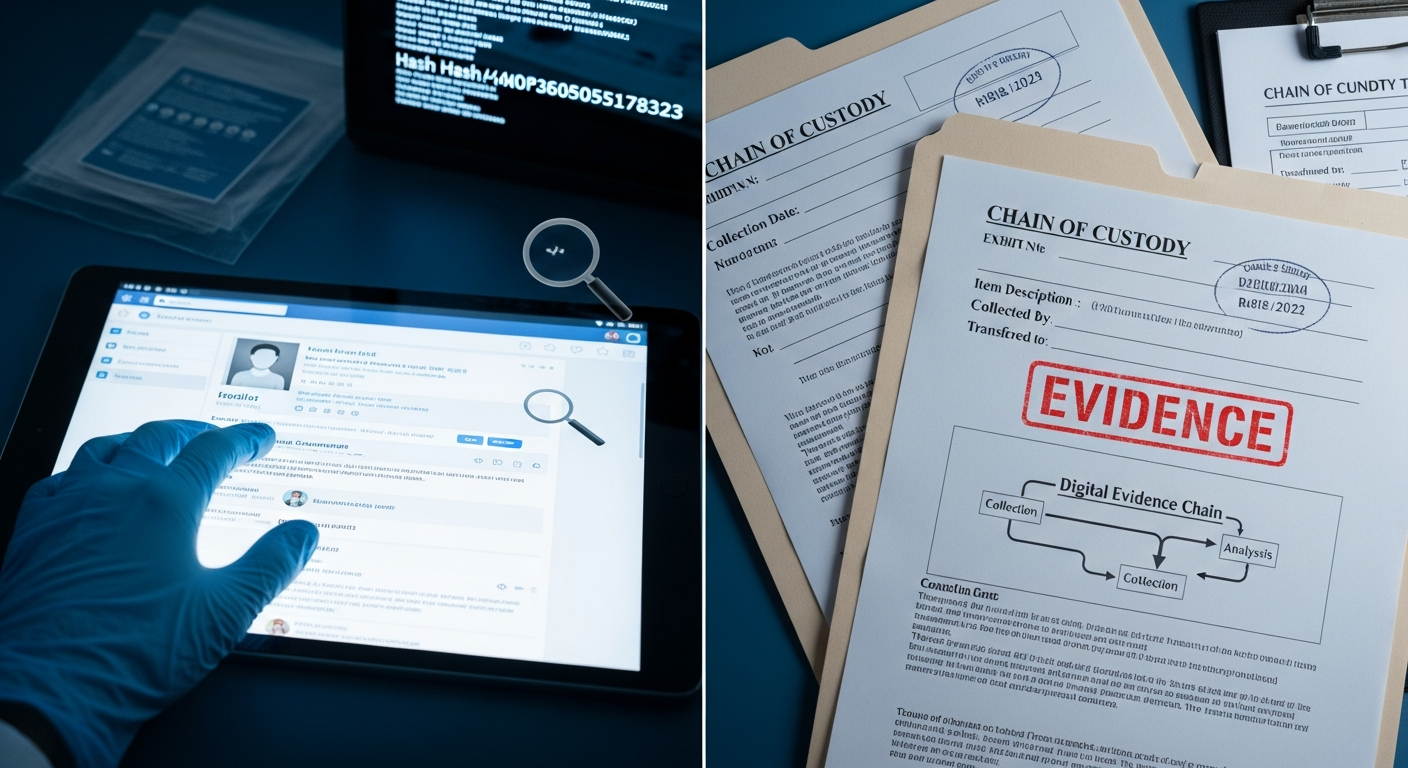
Digital Evidence Authentication: A Guide for Legal Teams
A screenshot of a deleted tweet. A viral Instagram post that contradicts sworn testimony. A network of accounts spreading coordinated misinformation. Social media evidence can make or break a case—but only if it survives scrutiny in court.
Introduction
The legal landscape has transformed dramatically as social media platforms have become primary theaters for human activity. From defamation cases built on tweet threads to employment disputes hinging on Instagram posts, digital evidence now appears in courtrooms with increasing frequency. Yet the ephemeral, easily manipulated nature of social media content creates unique authentication challenges that legal teams must navigate carefully.
The stakes are significant. Evidence that cannot be authenticated is evidence that cannot be admitted. And inadmissible evidence, regardless of how compelling it might be, cannot influence a verdict. Understanding the chain of custody requirements, authentication standards, and best practices for digital evidence collection has become an essential competency for modern legal practice.
The Authentication Challenge for Social Media Evidence
Traditional evidence authentication relies on established chains of custody—physical items secured, logged, and transported under documented conditions. Social media evidence presents fundamentally different challenges. Posts can be edited, deleted, or modified. Accounts can be impersonated. Screenshots can be fabricated. Metadata can be stripped or manipulated.
Courts have responded with varying standards, but the Federal Rules of Evidence provide the foundation. Rule 901(b)(1) allows authentication through testimony from a witness with knowledge. Rule 901(b)(4) permits authentication through distinctive characteristics, including appearance and content. For digital evidence specifically, courts increasingly look for corroborating technical data that establishes both the content's existence and its connection to the purported author.
What Courts Actually Require
Authentication requirements vary by jurisdiction, but most courts expect legal teams to demonstrate:
- Origin verification: Proof that the content actually appeared on the platform claimed
- Author attribution: Evidence connecting the content to a specific individual or entity
- Temporal accuracy: Confirmation of when the content was created, modified, or deleted
- Content integrity: Assurance that the evidence has not been altered since collection
- Collection methodology: Documentation of how the evidence was gathered and preserved
The Maryland approach, established in Griffin v. State, requires circumstantial evidence connecting the purported author to the social media content beyond mere account ownership. The Texas standard, from Tienda v. State, allows authentication through the totality of circumstances including photographs, references to the defendant, and content patterns consistent with the defendant's life.
Establishing Chain of Custody for Digital Evidence
Chain of custody for social media evidence requires meticulous documentation from the moment of collection through presentation at trial. Unlike physical evidence that can be sealed in evidence bags, digital evidence exists as files that can be copied infinitely without degradation—but also without clear provenance unless proper protocols are followed.
Collection Documentation Requirements
Every evidence collection should document:
Environmental context: The device used, network connection, browser or application version, and collector identity. This establishes the technical environment and identifies potential sources of error or manipulation.
Timestamp verification: Multiple timestamp sources including system time, visible timestamps on the platform, and ideally independent time verification through services like the National Institute of Standards and Technology.
Access method: Whether content was accessed through direct URL, search function, or third-party tools. Different access methods may reveal different versions of content or metadata.
Complete capture: Full-page captures rather than cropped screenshots, including URL bars, surrounding content, and visible interface elements that establish platform authenticity.
Preservation Protocols
After collection, digital evidence must be preserved in ways that prevent alteration while maintaining accessibility. Best practices include:
- Calculating and recording cryptographic hash values (SHA-256 or better) immediately after capture
- Storing original files in write-once formats or media
- Maintaining multiple copies in geographically separate locations
- Documenting every access to the evidence with purpose, date, and accessor identity
- Using specialized forensic tools that embed hash verification within the evidence file
Metadata: The Hidden Authentication Layer
Raw screenshots capture what users see, but metadata captures what users cannot see—and metadata often provides the strongest authentication evidence. Social media platforms generate extensive metadata for every piece of content, including creation timestamps, modification history, engagement metrics, and technical identifiers.
Critical Metadata Elements
Post identifiers: Unique IDs assigned by platforms that remain constant even if usernames change or content is modified. A Twitter post ID, for instance, encodes creation timestamp information that can be independently verified.
Author identifiers: Platform-assigned user IDs that persist through username changes. These prevent the common defense that someone else using a similar username created the content.
Engagement data: Likes, shares, replies, and quote posts that create a web of corroborating evidence. If multiple independent accounts engaged with content, fabrication becomes exponentially more difficult to argue.
Account history: Verification status, account age, username change history, and posting patterns that establish account authenticity and attribution.
Authenticity Indicators
Advanced social media analysis can provide additional authentication support through authenticity scoring. Platforms generate behavioral signals—posting frequency, engagement patterns, network characteristics—that distinguish genuine accounts from fabricated ones. While not dispositive, evidence that an account shows indicators of inauthenticity can be valuable for impeachment, while evidence of authentic behavioral patterns can strengthen attribution arguments.
Common Authentication Failures
Legal teams face authentication challenges for predictable reasons. Understanding common failures helps prevent them.
Insufficient Contextual Evidence
A screenshot showing a post without visible URL, timestamp, or author information provides minimal authentication value. Courts have repeatedly rejected evidence that consists solely of printed screenshots without corroborating technical data.
Unverified Collection Timing
When evidence is collected weeks or months after the relevant events, opposing counsel will question whether the content existed in its current form at the time relevant to the case. Real-time or near-real-time collection provides the strongest temporal foundation.
Missing Source Attribution
Platform account names can be changed. Accounts can be hacked. Content can be posted by individuals other than account owners. Authentication must connect the specific content to the individual, not just to an account name that individual may have used.
Inadequate Expert Foundation
Complex digital evidence often requires expert testimony to explain collection methodology, metadata interpretation, and preservation protocols. Legal teams that attempt to introduce sophisticated digital evidence without qualified expert support frequently face successful authentication challenges.
How Xpoz Addresses This
Modern social media intelligence platforms provide capabilities that directly support authentication requirements. Xpoz, as a remote MCP server for social media intelligence, offers tools that legal teams can leverage for evidence collection and authentication support.
For establishing author attribution, the getTwitterUser and getInstagramUser tools retrieve comprehensive profile data including platform-assigned user IDs that persist through username changes, account creation dates, verification status, and historical username changes. This data helps establish that a specific account existed and was controlled by a particular individual at the time relevant to the case.
Network analysis through getTwitterUserConnections and getInstagramUserConnections can map relationships that corroborate attribution. If a purported author's account shows connections to known associates, family members, or colleagues, this circumstantial evidence strengthens authentication arguments.
Content retrieval tools like getTwitterPostsByIds and getInstagramPostsByIds capture posts with full metadata including creation timestamps, engagement metrics, and platform-assigned identifiers. The getTwitterPostComments and getInstagramCommentsByPostId tools can capture engagement context—the replies, comments, and interactions that create corroborating evidence of content existence.
For accounts where authenticity is challenged, Twitter-specific authenticity analysis fields including isInauthentic, isInauthenticProbScore, and inauthenticType provide computational assessment of account genuineness based on behavioral patterns.
The platform's CSV export functionality allows complete datasets to be downloaded for offline analysis and archival, creating preserved copies of evidence that can be hash-verified and maintained as part of formal chain of custody documentation.
Practical Examples
Example 1: Employment Dispute
An employee claims wrongful termination, alleging discriminatory statements by a supervisor. The employer's legal team needs to authenticate social media posts by the employee that contradict her stated timeline of events.
Authentication approach: Using getTwitterUser to retrieve the employee's complete profile including account creation date and historical username changes. Using getTwitterPostsByAuthor to collect all posts with full metadata. Documenting engagement through getTwitterPostInteractingUsers to identify accounts that interacted with relevant posts, creating corroborating evidence. Exporting complete dataset with timestamps and hash values for chain of custody documentation.
Example 2: Defamation Investigation
A business alleges defamation through a coordinated social media campaign. The legal team must authenticate the source accounts and establish their connection to the defendant.
Authentication approach: Using searchTwitterUsers and getTwitterUsersByKeywords to identify accounts participating in the campaign. Mapping network relationships through getTwitterUserConnections to identify coordination patterns. Capturing specific defamatory posts with getTwitterPostsByIds including full metadata. Analyzing account authenticity indicators to distinguish genuine accounts from potential fabrications.
Example 3: Intellectual Property Infringement
A brand discovers counterfeit products being promoted on Instagram. Legal needs to document the infringement with evidence suitable for both platform takedown requests and potential litigation.
Authentication approach: Using getInstagramPostsByKeywords to identify infringing content across the platform. Capturing specific posts with getInstagramPostsByIds including media URLs and engagement data. Documenting account details through getInstagramUser including follower networks that may indicate commercial scale. Preserving comment threads through getInstagramCommentsByPostId that may contain additional evidence of commercial activity.
Key Takeaways
-
Authentication is foundational: Without proper authentication, even the most compelling social media evidence may be inadmissible. Invest in authentication from the moment of collection, not as an afterthought before trial.
-
Metadata matters more than screenshots: Visual captures are starting points, not endpoints. Platform-assigned identifiers, engagement data, and technical metadata provide the corroborating evidence courts increasingly require.
-
Chain of custody must be documented contemporaneously: Post-hoc documentation of collection procedures invites credibility challenges. Establish and follow written protocols that create real-time documentation of every step in the evidence lifecycle.
-
Tools must match requirements: Ad hoc screenshot collection rarely survives sophisticated authentication challenges. Purpose-built social media intelligence platforms provide the technical capabilities—comprehensive metadata capture, engagement analysis, network mapping, and export functionality—that support robust authentication.
-
Expert support strengthens foundation: Complex digital evidence benefits from qualified expert testimony that can explain collection methodology, interpret metadata, and establish authenticity to courts unfamiliar with social media technicalities.
Conclusion
The evidentiary value of social media content is undeniable—but only when that content can be properly authenticated and its chain of custody established. Legal teams that develop expertise in digital evidence authentication position themselves to leverage social media content effectively, while those who treat authentication as an afterthought risk having critical evidence excluded at the worst possible moment.
The tools and protocols for robust social media evidence collection exist. The question is whether legal teams will implement them proactively or learn their necessity through painful exclusion rulings. In an era where social media posts increasingly determine case outcomes, authentication competency has become not just an advantage but a professional necessity.
For legal teams ready to strengthen their digital evidence capabilities, exploring platforms like Xpoz that provide comprehensive metadata capture, network analysis, and export functionality represents a practical next step toward authentication-ready evidence collection.