
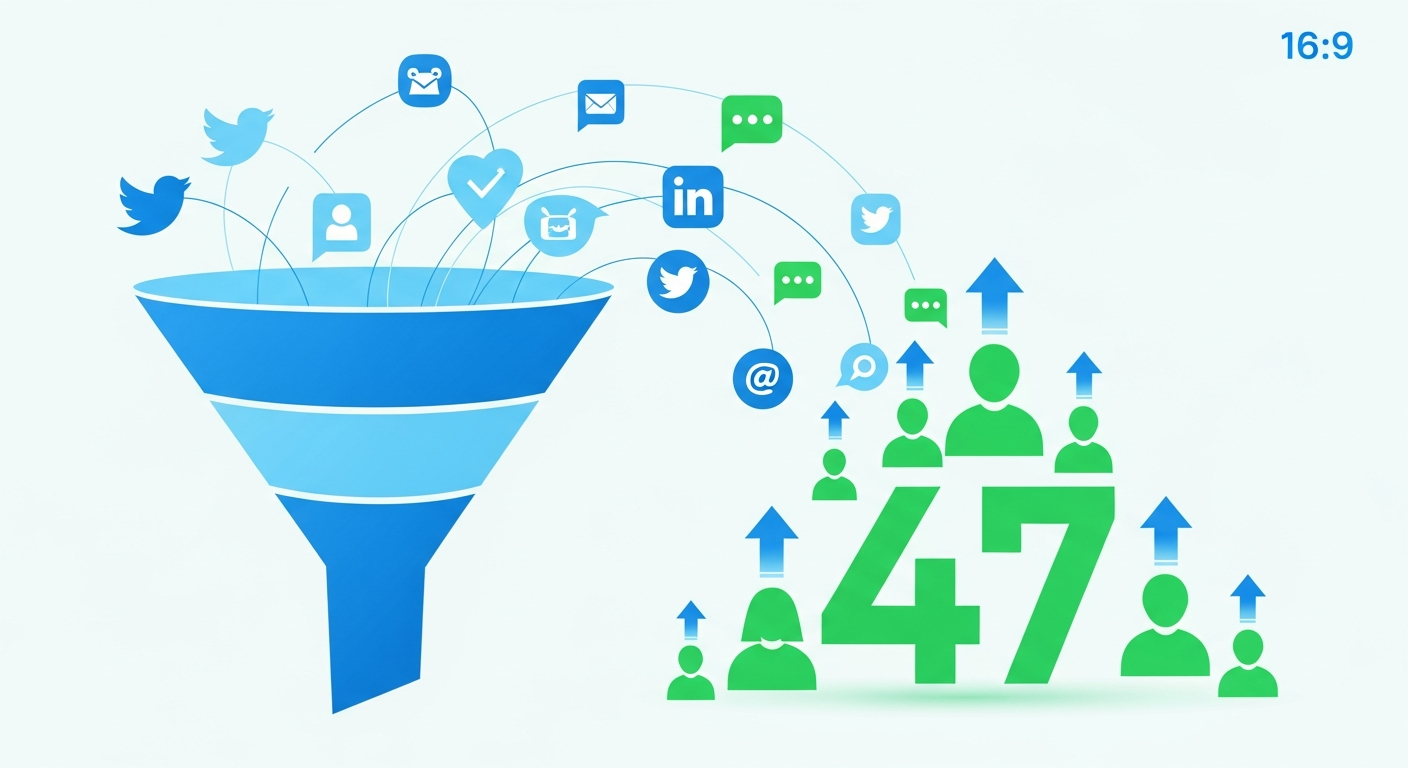
From Social Signals to 47 Qualified Leads in One Week
When Marcus Chen, head of sales at a mid-sized B2B SaaS company, mentioned during a team standup that they'd generated 47 qualified leads in a single week using social listening, his colleagues assumed he'd finally cracked some expensive intent data platform. The reality was simpler—and far more accessible.
His team had learned to read the digital room.
Introduction
Traditional lead generation operates on a frustrating paradox: by the time someone fills out a form or requests a demo, they've often already made up their mind. Studies consistently show that B2B buyers complete 60-70% of their decision-making process before ever talking to sales.
The real opportunity lives upstream—in the conversations happening right now on social media. People publicly discuss their frustrations, ask for recommendations, compare solutions, and signal buying intent dozens of times before entering any sales funnel.
This case study examines how one team transformed their approach to lead generation and social selling by systematically mining social signals, resulting in 47 qualified conversations in seven days.
The Problem with Traditional Lead Generation
Marcus's team had been playing the same game as everyone else: content marketing, paid ads, and hoping the right people would find them. Their monthly qualified lead count hovered around 30-40, with conversion rates that made leadership nervous.
"We were basically waiting for people to come to us," Marcus explained. "Meanwhile, hundreds of potential buyers were publicly saying things like 'Does anyone have experience with [competitor]?' or 'We need to solve [exact problem our product addresses]' and we had no idea."
The challenge wasn't creating demand—it was finding the demand that already existed.
The Hidden Cost of Reactive Selling
Every day Marcus's team missed:
- Direct requests for product recommendations in their category
- Complaints about competitors that signaled switching intent
- Technical questions that indicated active evaluation
- Hiring posts that revealed budget allocation for their solution area
These weren't hypothetical opportunities. They were real conversations, happening publicly, with people who had genuine purchasing authority.
The Shift to Signal-Based Prospecting
The transformation began when Marcus's team started treating social media not as a broadcast channel but as an intelligence source. Instead of pushing content and hoping for engagement, they began systematically monitoring for buying signals.
Defining What "Buying Intent" Looks Like
Before any technology comes into play, teams need to understand what buying signals actually look like in their market. For Marcus's team, selling project management software to mid-market companies, the signals included:
Direct Intent Signals:
- "Looking for recommendations for [product category]"
- "Anyone switched from [competitor] recently?"
- "What's everyone using for [use case]?"
Indirect Intent Signals:
- Complaints about current tooling limitations
- Questions about specific features their product excelled at
- Hiring for roles that would use their product
- Mentions of growth milestones that typically trigger tool evaluation
Competitor Signals:
- Frustration with competitor pricing or support
- Questions about competitor limitations
- Discussions comparing alternatives
Building the Monitoring Framework
The team created a systematic approach to capture these signals across platforms. Rather than manual scrolling—which doesn't scale and misses most relevant conversations—they needed infrastructure that could:
- Monitor keyword patterns indicating buying intent
- Surface the humans behind the posts, not just the content
- Provide enough context to craft relevant outreach
- Distinguish between casual mentions and genuine interest
The Week That Changed Everything
With their signal framework defined, Marcus's team ran a focused seven-day experiment. Here's how it unfolded.
Day 1-2: Casting the Net
The team set up monitoring for their core intent keywords across Twitter and Instagram. They weren't looking for mentions of their brand—they were looking for the problems their product solved.
Queries included variations of:
- "project management tool recommendations"
- "switching from [competitor names]"
- "need better collaboration software"
- Complaints containing keywords like "missed deadlines," "team coordination," and "project visibility"
Within the first 48 hours, they identified 156 potentially relevant conversations.
Day 3-4: Signal Validation
Not every mention indicates buying intent. The team developed a quick scoring system:
High Intent (reach out immediately):
- Direct requests for recommendations
- Explicit statements about evaluation or switching
- Budget-related mentions
Medium Intent (nurture opportunity):
- General frustration without action signals
- Questions that indicate early-stage research
- Engagement with competitor content
Low Intent (note for later):
- Generic industry discussions
- Content creation rather than genuine questions
- Influencers reviewing products
Of the 156 conversations, 89 scored as high or medium intent.
Day 5-7: Intelligent Outreach
Here's where most teams fail. They identify signals but then blast generic pitches that feel invasive. Marcus's team took a different approach.
For each high-intent signal, they:
-
Researched the person's context - What company? What role? What other challenges had they mentioned?
-
Crafted relevant responses - Not pitches, but genuinely helpful contributions to the conversation. If someone asked for recommendations, they'd share their perspective along with alternatives. If someone complained about a problem, they'd offer insight regardless of product fit.
-
Provided value before asking for anything - The first interaction was never a sales pitch. It was participation in a conversation the prospect had already started.
-
Used appropriate channels - Public responses for public questions, direct messages only when the conversation naturally progressed there.
The result: 47 qualified conversations from 89 outreach attempts—a 52% response rate that dwarfed their typical cold outreach performance of 3-5%.
How Xpoz Addresses This
The manual version of this process is theoretically possible but practically exhausting. Searching multiple platforms, cross-referencing profiles, tracking conversations over time, and maintaining context across dozens of simultaneous opportunities requires infrastructure.
Xpoz provides this infrastructure through its social intelligence capabilities. Here's how the toolkit maps to the lead generation workflow:
Finding the Conversations
Using keyword-based post search, teams can monitor for buying intent signals across Twitter and Instagram simultaneously. The query syntax supports boolean operators, meaning you can create sophisticated monitoring rules:
("looking for" OR "recommendations for" OR "anyone use")
AND ("project management" OR "collaboration tool" OR "team coordination")
This surfaces posts where people are actively seeking solutions—the highest-intent signals available.
Understanding the Humans Behind the Signals
Finding a relevant post is only step one. Effective outreach requires understanding who you're talking to. Xpoz's user research tools provide profile analysis including:
- Follower counts and engagement metrics (indicates influence and reach)
- Bio information and professional context
- Posting history and typical content themes
- Network connections (who else do they engage with?)
This context transforms a generic response into a relevant conversation.
Scaling Without Losing Quality
The pagination and CSV export features enable teams to process larger volumes while maintaining systematic tracking. Rather than manually scrolling and losing track of which conversations they've addressed, teams can:
- Export daily signal reports
- Score and prioritize in their CRM
- Track outreach and responses
- Measure what signal types convert best
Identifying Patterns Over Time
The count and trending analysis capabilities reveal which topics are gaining momentum. For lead generation, this means:
- Spotting emerging competitor vulnerabilities before they become common knowledge
- Identifying seasonal patterns in buying behavior
- Understanding which pain points resonate most with your target audience
Practical Examples
Example 1: The Competitor Complaint
The Signal: A marketing director tweets: "Third time this month [Competitor] has crashed during our team standup. This is getting ridiculous."
The Research: Using user profile analysis, the team discovers she's at a 200-person company (perfect ICP), has 2,400 followers (moderate influence), and frequently posts about marketing operations.
The Approach: Rather than immediately pitching, a team member responds with genuine empathy and a question: "That's brutal timing. Are you locked into an annual contract or evaluating alternatives?" This opens dialogue without being pushy.
The Outcome: She responds that they're month-to-month and actively looking. A conversation that started on Twitter moves to a proper discovery call.
Example 2: The Recommendation Request
The Signal: Someone in a relevant industry asks their followers: "Building out our ops stack. What's everyone using for project tracking across distributed teams?"
The Research: User analysis reveals he's a COO at a Series B startup, well-connected in the startup ecosystem, and the kind of person whose recommendation would influence others.
The Approach: A team member provides a thoughtful overview of options—including competitors—with honest pros and cons, positioning their product for the specific distributed team use case mentioned.
The Outcome: The prospect appreciates the balanced take, asks follow-up questions, and eventually requests a demo specifically because "you were the only ones who didn't just pitch your thing."
Example 3: The Network Approach
The Signal: A post about collaboration challenges doesn't directly ask for recommendations but indicates pain.
The Research: The poster has modest reach, but analysis of who's engaging with the post reveals several influential figures in the target industry.
The Approach: Rather than targeting the original poster, the team engages with the thread in a way that adds value to the broader conversation, earning visibility with the higher-value audience participating.
The Outcome: Two of the commenters reach out directly after seeing the helpful response, leading to conversations with larger companies.
Key Takeaways
-
Intent signals are public and plentiful. Every day, potential buyers discuss their needs, frustrations, and evaluations openly on social media. The challenge isn't finding demand—it's building systems to capture it.
-
Lead generation through social selling requires research, not just monitoring. Finding a relevant post is step one. Understanding the person behind it—their company, role, context, and network—determines whether outreach lands or falls flat.
-
Value-first engagement dramatically outperforms pitching. Marcus's team achieved a 52% response rate by contributing to conversations rather than hijacking them. People respond to helpfulness, not sales tactics.
-
Systematic processes beat sporadic efforts. The difference between occasional social selling success and consistent pipeline generation is infrastructure—clear signal definitions, research workflows, and tracking systems.
-
Speed matters but authenticity matters more. Responding quickly to buying signals creates advantage, but not at the cost of genuine, contextually relevant engagement.
Conclusion
Marcus's 47 qualified leads in one week wasn't a fluke or a hack. It was the result of recognizing a simple truth: the conversations that matter most to your business are already happening. The question is whether you're listening.
Traditional lead generation asks prospects to come to you—to find your content, fill out your forms, and request your demos. Signal-based prospecting inverts this model. You go to where prospects are already expressing interest, add value to conversations they've started, and earn the right to continue the dialogue.
The tools exist to do this systematically. The question is whether you'll keep waiting for leads to find you, or start finding the conversations that are already looking for what you offer.
The signals are there. They always have been.