
Social Media OSINT with AI: How Xpoz MCP Transforms Open Source Intelligence
The explosion of social media has created an unprecedented goldmine for open source intelligence. Every day, billions of posts, profiles, and interactions generate data that can reveal competitive movements, emerging threats, influential voices, and market sentiment. Yet traditional OSINT tools require analysts to manually piece together fragments across platforms, export data into spreadsheets, and perform analysis in disconnected workflows.
What if your AI assistant could directly query social media intelligence databases, synthesize findings across platforms, and present actionable insights—all within a natural conversation?
Introduction
Open source intelligence (OSINT) has evolved from a niche discipline practiced by government agencies into an essential capability for businesses, journalists, researchers, and security professionals. Social media platforms like Twitter and Instagram have become primary sources for real-time intelligence, offering windows into public sentiment, network relationships, and behavioral patterns.
Traditional social media OSINT involves a fragmented process: searching platform interfaces manually, using specialized scraping tools, exporting data to CSV files, and analyzing results in separate applications. Each step introduces friction, delays, and opportunities for error. Worse, these tools typically provide raw data without contextual analysis, leaving investigators to manually synthesize meaning from thousands of data points.
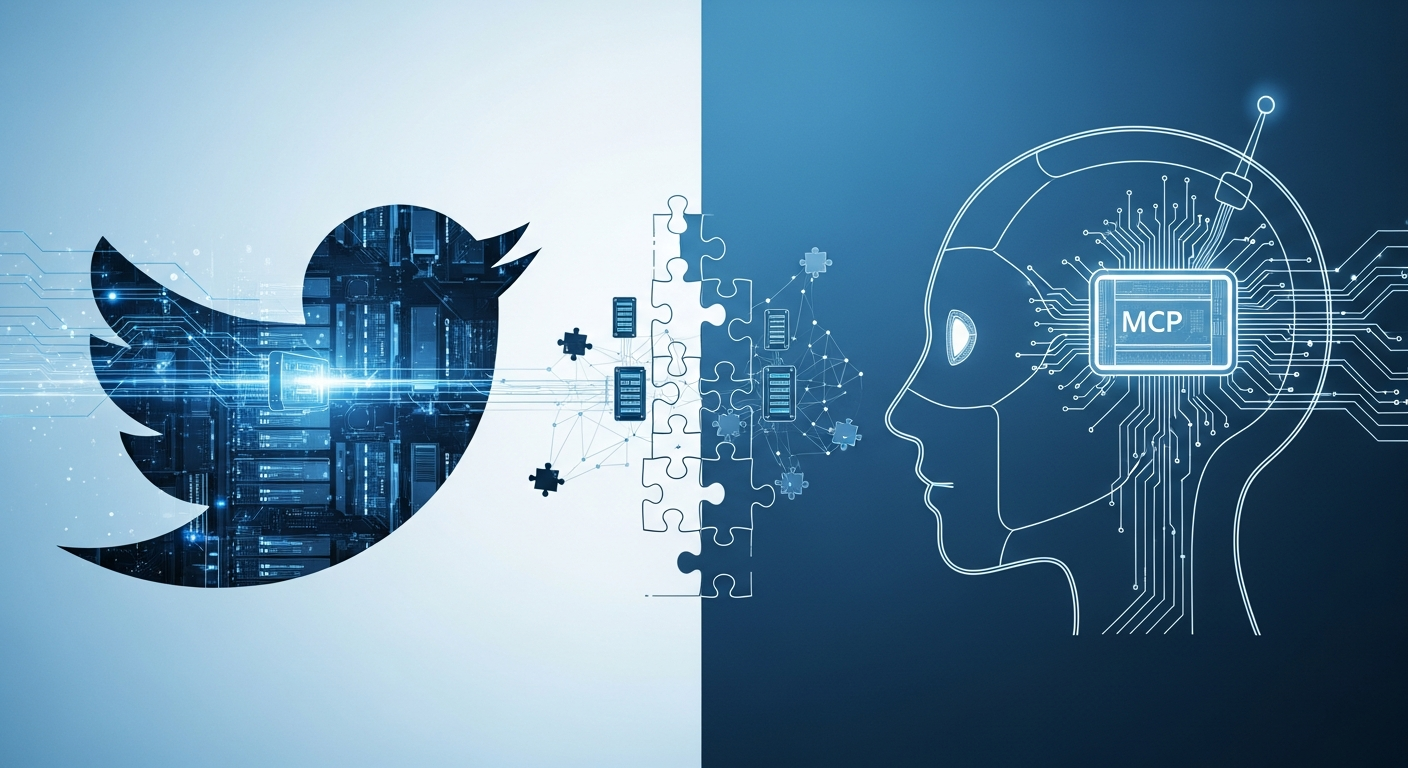
The emergence of AI-powered analysis capabilities—particularly through the Model Context Protocol (MCP)—creates an opportunity to fundamentally reimagine how social media OSINT works. Instead of treating data extraction and analysis as separate steps, MCP enables AI assistants to directly query intelligence databases and apply reasoning to the results in a unified workflow.
The Traditional OSINT Tool Landscape
Before examining how AI transforms social media OSINT, it's worth understanding the current toolkit landscape and its limitations.
Platform-Native Search
The most basic approach involves using Twitter's advanced search, Instagram's explore features, or platform APIs directly. While free and accessible, platform-native search suffers from severe limitations: restricted historical access, rate limiting, incomplete results, and no cross-platform correlation. Investigators often miss critical data simply because platform interfaces aren't designed for systematic intelligence gathering.
Specialized OSINT Tools
Tools like Maltego, SpiderFoot, and various social media scrapers address some of these gaps by aggregating data and visualizing relationships. However, they typically require:
- Significant technical expertise to configure and operate
- Manual export and import workflows between tools
- Separate analysis steps in spreadsheets or databases
- Individual API keys and authentication management for each platform
The Analysis Gap
Even sophisticated OSINT tools focus primarily on data collection, leaving analysis to the investigator. Identifying patterns across thousands of accounts, assessing authenticity, mapping influence networks, and synthesizing findings into actionable intelligence remains labor-intensive work that demands both technical skills and analytical expertise.
How AI Changes the OSINT Equation
AI assistants like Claude excel at exactly the cognitive tasks that traditional OSINT tools struggle with: pattern recognition across large datasets, natural language synthesis, contextual reasoning, and adaptive investigation strategies. The Model Context Protocol (MCP) bridges the gap between AI reasoning capabilities and specialized data sources.
From Query to Insight in One Conversation
Consider a typical OSINT investigation: identifying key influencers discussing a specific topic and assessing their authenticity. Traditionally, this requires:
- Searching for users mentioning the topic
- Exporting results to a spreadsheet
- Manually reviewing each profile
- Researching account histories
- Cross-referencing engagement patterns
- Writing up findings
With an MCP-connected AI assistant, the same investigation becomes a conversation:
"Find Twitter users who have been discussing AI regulation in the past month, ranked by their influence and engagement. For the top accounts, assess their authenticity based on account age, posting patterns, and follower ratios."
The AI can query the intelligence database, retrieve relevant user data with authenticity metrics, and synthesize findings—all within a single interaction.
Contextual Follow-Up
Unlike static tools, AI assistants maintain conversational context. If initial results reveal an interesting cluster of accounts, you can immediately explore deeper:
"Several of those accounts seem connected. Map the follower relationships between the top 5 most influential accounts you found."
The AI understands "those accounts" refers to previous results and can execute network analysis without requiring you to re-specify parameters or export data.
Try this with Xpoz
No API keys needed. Query Twitter, Reddit, Instagram & TikTok with natural language.
Xpoz MCP: Social Media Intelligence for AI Assistants
Xpoz provides a remote MCP server that gives AI assistants direct access to comprehensive social media intelligence across Twitter/X and Instagram. Rather than replacing traditional OSINT tools, it enables a new paradigm where AI reasoning and social media data work together seamlessly.
Twitter Intelligence Capabilities
For Twitter/X investigations, Xpoz provides tools across three core areas:
User Research includes retrieving detailed profiles with authenticity analysis, searching users by name or description, mapping follower/following networks, and discovering users who discuss specific topics. Critically, user data includes authenticity indicators like bot probability scores, account age, username change history, and engagement authenticity metrics.
Content Analysis enables keyword searches with boolean operators, author-specific post retrieval, and volume tracking over time. Investigators can monitor brand mentions, track trending topics, or analyze historical posting patterns.
Engagement Analysis reveals who interacted with specific posts—commenters, quote tweeters, retweeters—enabling amplification analysis and audience profiling for viral content.
Instagram Intelligence Capabilities
For Instagram investigations, similar capabilities cover:
User Research for profile analysis, influencer discovery, and network mapping within the platform's visual-first ecosystem.
Content Analysis including caption and subtitle search, user timeline retrieval, and post verification.
Engagement Analysis revealing commenters and likers on specific posts for audience profiling.
Built-In Authenticity Assessment
A standout capability for social media OSINT is built-in authenticity analysis. For Twitter accounts, Xpoz provides:
isInauthentic: Boolean flag for suspected inauthentic accountsisInauthenticProbScore: Probability score for bot/inauthentic behaviorinauthenticType: Classification of the type of inauthenticity detectedusernameChanges: History of username modificationsverifiedSinceDatetime: When verification status was obtained
These fields transform what would typically require separate bot-detection tools and manual analysis into immediately actionable intelligence.
Practical OSINT Investigation Examples
Example 1: Competitive Intelligence Monitoring
Scenario: A technology company wants to monitor discussions about a competitor's new product launch.
Investigation Approach:
"Search Twitter for posts mentioning [CompetitorProduct] from the past
two weeks. Include engagement metrics and identify which posts had the
highest amplification."
The AI queries getTwitterPostsByKeywords with appropriate date filters, retrieves posts with engagement data (retweets, quotes, replies, impressions), and identifies the highest-performing content.
Follow-up Analysis:
"For the most viral post about [CompetitorProduct], who were the main
amplifiers? Are any of them verified accounts or likely to be
industry influencers?"
Using getTwitterPostInteractingUsers, the AI retrieves retweeters and quote tweeters, then analyzes their profiles to identify genuine influencers versus low-value accounts.
Example 2: Influence Network Mapping
Scenario: A journalist investigating astroturfing wants to identify whether accounts promoting a specific hashtag are coordinated.
Investigation Approach:
"Find Twitter users who posted about #SaveLocalBusiness in the past
month. Focus on accounts with high posting volume on this topic.
Include authenticity metrics."
The AI uses getTwitterUsersByKeywords to find active posters, requesting fields like avgTweetsPerDayLastMonth, isInauthenticProbScore, and createdAt.
Network Analysis:
"For accounts with high inauthenticity scores, map their follower
overlaps. Do they follow each other or share common followers
that might indicate coordination?"
Using getTwitterUserConnections, the AI can retrieve follower lists and identify suspicious network patterns suggesting coordinated activity.
Example 3: Crisis Monitoring
Scenario: A brand manager notices negative sentiment emerging and needs rapid intelligence.
Investigation Approach:
"Count mentions of [BrandName] on Twitter for each day over the past
week, and identify any significant spikes."
Using countTweets with date ranges, the AI provides volume data showing when negative discussion intensified.
Deep Dive:
"For the spike on [specific date], retrieve the most-engaged posts
mentioning [BrandName]. What themes emerge in the criticism?"
The AI retrieves high-engagement posts from the spike period and synthesizes common themes—something traditional tools require manual analysis to accomplish.
Boolean Query Power for Precision Searches
Effective social media OSINT depends on precise queries. Xpoz supports boolean operators that enable sophisticated searches:
| Query Type | Example | Use Case |
|---|---|---|
| Exact phrase | "artificial intelligence" | Find specific terminology |
| OR logic | AI OR "machine learning" | Capture topic variations |
| AND logic | "deep learning" AND ethics | Require multiple concepts |
| Complex boolean | (AI OR "artificial intelligence") AND regulation | Nuanced topic filtering |
| Exclusion | (startup OR entrepreneur) NOT "venture capital" | Remove noise |
These operators apply across keyword searches for both posts and users, enabling investigators to craft highly targeted queries that reduce noise and surface relevant intelligence.
Operational Considerations
Asynchronous Operations and Pagination
Large-scale OSINT queries—retrieving thousands of followers or comprehensive post datasets—operate asynchronously. The AI handles this transparently: initiating queries, polling for completion, and paginating through results as needed.
For comprehensive analysis, results can be exported to CSV format, enabling offline statistical analysis or archival while maintaining the conversational workflow for real-time intelligence.
Data Freshness and Caching
By default, Xpoz uses intelligent caching with automatic refresh for data older than one week. For time-sensitive investigations, forcing latest data retrieval ensures real-time intelligence—though this increases latency and should be used judiciously.
Coverage Awareness
Social media databases may have partial coverage. The AI can communicate coverage limitations when they affect results, helping investigators understand whether findings represent comprehensive data or a sample requiring additional verification.
Key Takeaways
-
AI transforms OSINT workflow: Instead of extract-export-analyze cycles, AI assistants can query intelligence databases and synthesize findings in unified conversations.
-
Authenticity assessment is built-in: Bot detection, account age analysis, and behavioral scoring integrate directly into user intelligence, eliminating the need for separate tools.
-
Boolean queries enable precision: Sophisticated search operators allow investigators to craft targeted queries that surface relevant intelligence while filtering noise.
-
Conversational context accelerates investigations: Follow-up questions build on previous results without re-specifying parameters, enabling adaptive investigation strategies.
-
Network analysis reveals hidden patterns: Mapping follower relationships and engagement patterns exposes coordination, influence structures, and community dynamics.
Conclusion
Social media OSINT has traditionally required investigators to juggle multiple tools, manage complex data exports, and perform analysis in disconnected workflows. The combination of AI reasoning capabilities and direct access to social media intelligence through MCP represents a fundamental shift: from tools that extract data to assistants that deliver insights.
Xpoz MCP enables this shift by providing Claude and other AI assistants with comprehensive Twitter and Instagram intelligence, complete with authenticity metrics, network mapping, and engagement analysis. Investigations that previously required hours of manual work across multiple tools can now unfold as natural conversations.
For OSINT practitioners ready to experience this new paradigm, getting started takes approximately two minutes: connect to the remote MCP server at https://mcp.xpoz.ai/mcp through Claude's settings, authenticate, and begin your first AI-powered investigation.