
TikTok Brand Monitoring: A Practical Guide for 2026
Your brand is being discussed on TikTok right now — in a creator's product haul, a stitched complaint video, a comment thread under a competitor's ad. The question isn't whether the conversation is happening. It's whether you're hearing it before it shapes how millions of people see you.
Introduction
TikTok brand monitoring is the practice of systematically tracking how your brand, products, and competitors are mentioned across TikTok videos, captions, sounds, and comments — then turning those signals into action. With over a billion monthly active users and an algorithm that can push a single clip to millions overnight, TikTok has become the platform where reputations are made and unmade fastest.
The challenge is that TikTok conversations are messy. People misspell your name, reference you in spoken audio rather than text, and bury sentiment in comment sections rather than captions. A complaint that would surface instantly on Twitter/X can sit quietly inside a video's audio for days before it breaks out. This guide walks through what TikTok brand monitoring actually requires in 2026, the tactics that work, and how to build a listening stack that catches signals across every platform that matters.
Why TikTok Brand Monitoring Is Different in 2026
TikTok brand monitoring demands more than keyword scanning because the most important mentions are often spoken, visual, or hidden in comments rather than written in captions. Roughly 40% of younger users now treat TikTok as a search engine, which means brand discovery — and brand damage — increasingly originates here rather than on Google.
Three structural differences make TikTok harder to monitor than text-first platforms:
| Factor | Twitter/X & Instagram | TikTok |
|---|---|---|
| Primary mention surface | Caption / post text | Spoken audio, on-screen text, comments |
| Virality speed | Hours to days | Minutes to hours |
| Sentiment location | Post body | Comment threads and stitches |
| Searchability of mentions | High (text-native) | Partial (audio needs transcription) |
The practical takeaway: effective TikTok mention tracking has to reach into video subtitles and comment sections, not just captions. Brands that monitor only hashtags miss the majority of relevant conversation.
Core Tactics for Monitoring Your Brand on TikTok
To monitor your brand on TikTok effectively, combine four tracking layers: brand-name mentions, product and campaign terms, competitor activity, and category conversations. Running all four in parallel catches both direct callouts and the ambient sentiment that predicts where opinion is heading.
1. Track Brand and Product Mentions
Start with the obvious terms — your brand name, product lines, and campaign hashtags — but expand to misspellings, abbreviations, and slang. A skincare brand called "GlowLab" should also track "glow lab," "glowlabs," and any nickname its community uses. Set up TikTok brand alerts so a spike in volume triggers a notification within minutes, not at the end of a weekly report.
2. Track Competitors
TikTok competitor tracking reveals which messages resonate, which creators rivals partner with, and where audiences overlap with yours. Monitor competitor brand names, their flagship products, and the hashtags they own. When a competitor's video unexpectedly takes off, you want to understand the hook fast enough to respond in your own content cycle.
3. Monitor Sentiment, Not Just Volume
Volume tells you something is happening; sentiment tells you whether it's good. TikTok reputation monitoring means reading the comment threads under videos that mention you, because that's where genuine reaction lives. A product review with neutral narration can sit above a comment section full of complaints — or praise.
4. Identify Amplifiers Early
When a critical or laudatory video starts spreading, the accounts stitching and quoting it determine how far it goes. Identifying these amplifiers early lets you engage the right voices — thanking advocates, addressing critics — before the narrative hardens.
Try this with Xpoz
No API keys needed. Query Twitter, Reddit, Instagram & TikTok with natural language.
Choosing TikTok Listening Tools
The best TikTok listening tools cover three capabilities: deep mention coverage including audio and comments, real-time alerting, and cross-platform reach so a TikTok story doesn't blindside you when it jumps to other networks. Most "social listening" suites are strong on text platforms and weak on video, so evaluate carefully against the criteria below.
A practical evaluation checklist:
- Coverage depth. Does the tool see captions only, or also comments and transcribed audio?
- Alert latency. Are alerts real-time, or batched into daily digests that arrive too late?
- Cross-platform reach. Can it correlate a TikTok mention with related Twitter/X and Instagram chatter as a story spreads?
- Query precision. Can you use boolean logic to filter noise, or are you stuck with single keywords?
- Export and analysis. Can you pull raw data for your own reporting, or are you locked into a dashboard?
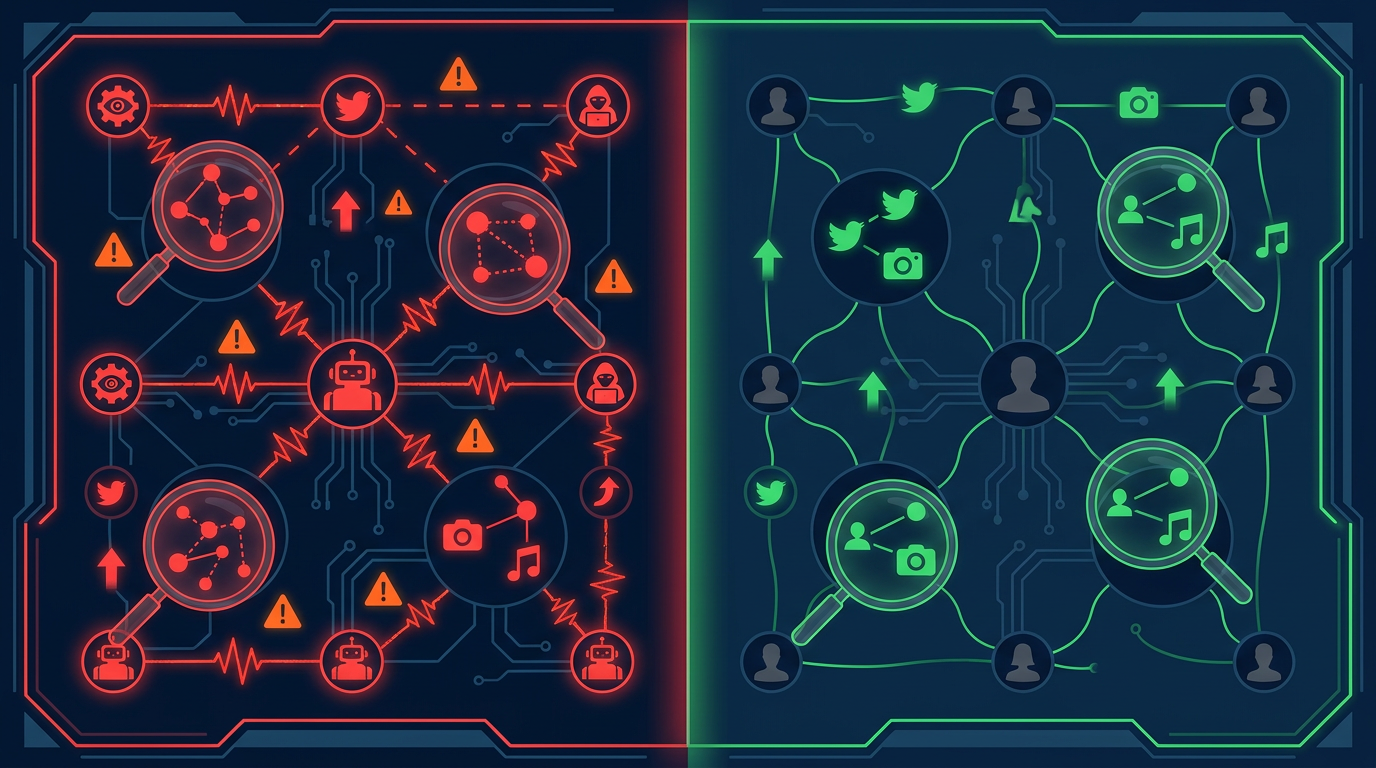
The cross-platform point matters more than it first appears. Stories rarely stay on one network. A TikTok clip gets clipped to Twitter/X, screenshotted to Instagram, and debated in comments across all three. Monitoring TikTok in isolation gives you a partial picture of a conversation that is, by 2026, almost always multi-platform.
How Xpoz Addresses This
Xpoz is a social media intelligence engine that gives AI assistants direct, queryable access to Twitter/X and Instagram data — the two platforms where TikTok stories most often spread, escalate, and get amplified. While TikTok is where many brand conversations start, the cross-platform jump is where they become a reputation event, and that's the layer Xpoz monitors with precision.
Here's how Xpoz strengthens a brand monitoring program:
- Mention tracking with boolean precision. Use
getTwitterPostsByKeywordsandgetInstagramPostsByKeywordsto track brand mentions with exact-phrase and boolean queries like("GlowLab" OR "glow lab") NOT "competitor", filtering noise out before it reaches your team. - Sentiment context from real discussion. Pull replies and comments with
getTwitterPostCommentsandgetInstagramCommentsByPostIdto read how people actually react, not just how loudly. - Volume and trend tracking. Use
countTweetsto measure mention volume over a date range, so you can detect spikes that signal a TikTok story crossing over. - Competitor tracking. Monitor rival brand mentions and audience overlap with the same keyword tools, and profile who engages using
getTwitterPostInteractingUsers. - Amplifier identification. Find the high-follower accounts spreading a post with
getTwitterPostRetweetsandgetTwitterPostQuotes, so you know who's driving reach. - Authenticity scoring. Twitter fields like
isInauthenticandisInauthenticProbScorehelp you tell real backlash from coordinated or bot-driven noise.
Because Xpoz is a remote intelligence layer your AI assistant connects to, you can ask plain-language questions — "Show me this week's Twitter mentions of our brand sorted by engagement" — and get structured, exportable results. Setup takes about two minutes with no platform API keys required, and the free tier covers 75,000 results (one-time).
Practical Examples
The fastest way to understand TikTok brand monitoring is to see it applied to real situations. Each example below shows the listening trigger and the response it enables.
Example 1: Catching a complaint before it trends. A beverage brand notices a TikTok review criticizing a new flavor. Within hours the clip is being quoted on Twitter/X. By running a keyword query for the brand and flavor name, the team surfaces the crossover early, reads the comment sentiment, and ships a response video before the criticism compounds.
Example 2: Measuring campaign lift. Before and after a TikTok campaign launch, the team uses volume counting on the campaign hashtag and branded terms across platforms to quantify the spillover into Twitter/X conversation — turning "it felt viral" into a measured 3x mention increase.
Example 3: Competitor benchmarking. A DTC apparel brand tracks a competitor's product launch. By monitoring competitor mentions and profiling who engages most, the team identifies five creators driving the rival's reach — and three who haven't yet partnered with anyone.
Example 4: Crisis triage. When a negative narrative spikes, the team pulls interacting users and checks authenticity scores to separate genuine customer frustration from an inauthentic pile-on, then prioritizes outreach to real, high-influence voices.
A simple monitoring cadence ties these together:
| Frequency | Action |
|---|---|
| Real-time | Brand-name and crisis-term alerts |
| Daily | Sentiment scan of new mentions and comments |
| Weekly | Competitor activity and amplifier review |
| Monthly | Volume trends and campaign measurement |
Key Takeaways
- TikTok brand monitoring requires reaching beyond captions into spoken audio and comment threads, where most real sentiment lives.
- Run four tracking layers in parallel: brand mentions, product and campaign terms, competitor tracking, and category conversation.
- Stories rarely stay on one platform — cross-platform reach is essential because TikTok clips routinely jump to Twitter/X and Instagram, where they escalate.
- Prioritize tools with real-time alerts, boolean query precision, and exportable data over dashboard-only suites.
- Xpoz adds the cross-platform intelligence layer, with boolean mention tracking, sentiment context, competitor analysis, and authenticity scoring across Twitter/X and Instagram.
Conclusion
The brands that win on TikTok in 2026 aren't the ones with the biggest budgets — they're the ones that hear the conversation first and respond while it still matters. Effective TikTok brand monitoring means catching mentions early, reading genuine sentiment, watching competitors, and tracking stories as they spread across every platform. Build that listening discipline now, and connect a cross-platform intelligence engine like Xpoz to your AI assistant to monitor the Twitter/X and Instagram chatter where TikTok stories escalate. Connect to the remote Xpoz MCP server in about two minutes and start tracking brand mentions free, up to 75,000 results (one-time).