
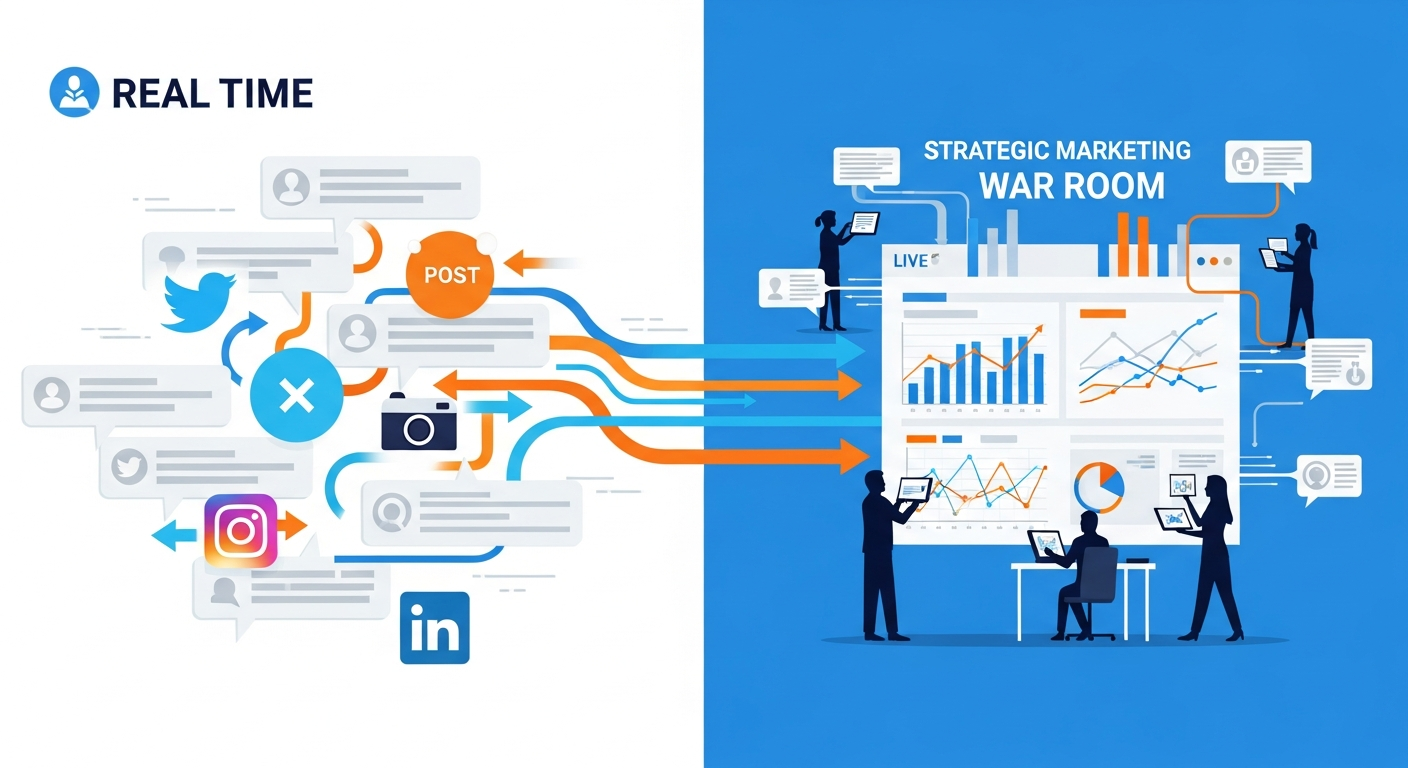
Why Real-Time Social Data Matters for Go-to-Market Strategy
The startup had everything going for it: a solid product, experienced team, and $12 million in funding. Yet their product launch fell flat. The reason? They'd built their entire GTM strategy on market research that was six months old. By the time they launched, the conversation had shifted, a competitor had captured the narrative, and their carefully crafted messaging missed the mark entirely.
This scenario plays out more often than most companies admit. In a world where market sentiment can shift in hours and new competitors emerge overnight, building a GTM strategy on static data is like navigating with last year's map.
Introduction
Go-to-market strategy has always been part science, part art. The science involves understanding your market, identifying the right customers, and crafting positioning that resonates. The art lies in timing—knowing when to enter, how to adapt, and where to focus limited resources.
What's changed is the pace. The traditional GTM playbook assumed markets moved slowly enough that quarterly research cycles could keep you informed. That assumption no longer holds. Customer preferences evolve in real-time. Competitive dynamics shift weekly. The conversations that shape market perception happen continuously across social platforms.
This is why real-time data has become essential infrastructure for modern GTM strategy. Not as a nice-to-have addition to existing research, but as a fundamental input that shapes every stage of market entry and expansion.
The Real Cost of Stale Market Intelligence
Most companies recognize that market research matters. Few have confronted how quickly that research becomes outdated.
Consider the shelf life of traditional GTM inputs:
Customer interviews and surveys capture a moment in time. By the time you've conducted 50 interviews, transcribed them, identified patterns, and synthesized insights, the earliest interviews may already reflect outdated thinking. Markets don't pause while you analyze.
Competitive analysis often relies on public announcements, press releases, and product pages. But the real competitive landscape—what customers actually think about alternatives, which features matter most, where competitors are gaining or losing ground—lives in daily conversations that traditional analysis never captures.
Persona development typically treats customer segments as static categories. In reality, the problems your personas face, the language they use to describe those problems, and the solutions they're evaluating all evolve continuously.
The cost of this staleness compounds at each stage of GTM execution. Messaging built on outdated pain points falls flat. Sales teams pursue accounts that have already chosen competitors. Marketing campaigns target segments that have moved on. Each misalignment burns budget and erodes the window of opportunity that GTM strategies are designed to capture.
When Six Weeks Becomes Six Months
The gap between market reality and GTM planning tends to widen over time. Here's why:
Initial research creates a snapshot. That snapshot informs positioning, which shapes messaging, which guides content creation, which drives campaign planning. Each step takes time and adds distance from the original market reality.
By the time campaigns launch, the insights that informed them may be months old. Worse, the planning process itself creates institutional momentum. Teams become invested in the strategy they've built. Changing course requires admitting the foundation has shifted—a conversation most organizations avoid until performance metrics force it.
Real-time data breaks this pattern by making market reality continuously visible. When you can see customer conversations as they happen, outdated assumptions surface immediately rather than accumulating into strategic blind spots.
Three Dimensions of Real-Time Intelligence for GTM
Effective GTM strategy requires intelligence across three dimensions: customer, competitive, and market. Real-time social data transforms each.
Customer Intelligence: Beyond Static Personas
Traditional persona development asks: Who are our customers? What do they care about? What problems do they face?
Real-time intelligence adds crucial dimensions: What are they discussing right now? How is their language evolving? What new concerns have emerged this week?
This isn't about replacing foundational customer research. It's about keeping that research alive. When you can monitor actual customer conversations continuously, you see how pain points manifest in real language, which competitors customers are actively evaluating, and how their criteria shift over time.
The practical impact shows up in messaging precision. GTM teams that monitor real-time customer conversations catch linguistic shifts early. They notice when customers start using different terms for familiar problems. They see which benefit claims generate engagement and which fall flat.
For example, a B2B software company might discover through social monitoring that their target customers have stopped talking about "digital transformation" and started discussing "operational resilience." That linguistic shift signals a deeper change in priorities—one that should reshape everything from landing pages to sales scripts.
Competitive Intelligence: The Conversation Behind the Press Release
Competitive analysis traditionally focuses on what competitors say about themselves. Real-time social intelligence reveals what customers say about competitors—a far more valuable signal.
This includes:
- Sentiment patterns: Are customers increasingly frustrated with a competitor? Enthusiastic about a new feature? Confused about pricing changes?
- Comparison conversations: When prospects evaluate alternatives, what criteria do they emphasize? What misconceptions do they hold?
- Share of voice: How much attention does each competitor command? Is that share growing or declining?
- Amplification networks: Who influences perception of competitors? Which voices carry weight in your market?
This intelligence directly shapes GTM tactics. If real-time monitoring reveals growing frustration with a competitor's customer support, that becomes a positioning lever. If prospects consistently misunderstand your differentiation, that signals a messaging gap to close.
Market Intelligence: Timing and Trends
Markets have rhythms that traditional research rarely captures. Seasonal patterns, event-driven spikes, news cycle impacts—all create windows of opportunity and risk that GTM strategy should account for.
Real-time monitoring makes these patterns visible. You can see when conversation volume around your category increases, identify the triggers, and prepare to capture that attention. You can spot emerging trends before they mature and position accordingly.
This temporal dimension particularly matters for GTM timing. Launching into a quiet market requires different tactics than entering amid intense conversation. Real-time intelligence helps you read the room and adjust accordingly.
The Feedback Loop Advantage
Perhaps the most significant benefit of real-time data is enabling fast feedback loops. Traditional GTM follows a linear path: research, plan, execute, measure, adjust. Each cycle takes months.
Real-time intelligence enables continuous adjustment. You can:
- Test messaging concepts by monitoring organic conversation around key themes
- Validate positioning by tracking how customers discuss alternatives
- Refine targeting by observing which audience segments engage most actively
- Adjust campaigns mid-flight based on real-time performance signals
This compression of feedback loops creates compounding advantages. Each adjustment improves the next iteration. Teams learn faster. Resources concentrate on what works.
Companies that master this feedback loop don't just execute better—they learn faster than competitors. That learning velocity becomes a sustainable advantage that compounds over time.
How Xpoz Addresses This
Building real-time intelligence capability traditionally required significant infrastructure: data engineering teams to manage API connections, analysts to process and interpret signals, custom dashboards to surface insights. The barrier to entry kept real-time intelligence out of reach for most GTM teams.
Modern tools have changed this equation. Xpoz, for instance, provides immediate access to social intelligence across Twitter and Instagram through a simple MCP server connection. No local installation, no API key management, no data engineering overhead.
The practical capabilities map directly to GTM needs:
For customer intelligence, tools like getTwitterUsersByKeywords and getInstagramUsersByKeywords identify users actively discussing relevant topics. This surfaces real-time signals about customer concerns, language patterns, and evaluation criteria. The aggregation fields—relevantTweetsCount, relevantTweetsLikesSum—help prioritize which conversations carry the most weight.
For competitive intelligence, keyword monitoring through getTwitterPostsByKeywords tracks mentions of competitors with full boolean query support. You can monitor "competitor name" AND "problem" to surface frustration signals, or track comparative discussions where prospects evaluate alternatives. The getTwitterPostComments and getTwitterPostQuotes tools reveal the commentary layer—what people say about competitive content, not just the content itself.
For market intelligence, countTweets enables volume tracking over time, making seasonal patterns and trend trajectories visible. The pagination and CSV export capabilities support deeper analysis when you need to process thousands of data points rather than sampling.
For audience analysis, connection mapping through getTwitterUserConnections reveals influence networks. Understanding who your target customers follow—and who follows them—shapes everything from influencer partnerships to content distribution strategy.
The async operation model and intelligent caching mean these queries work at scale without requiring real-time API management. You get the intelligence without the infrastructure burden.
Practical Examples
Abstract capabilities become concrete through examples. Here's how real-time intelligence applies to common GTM scenarios:
Scenario 1: Pre-Launch Intelligence Gathering
A SaaS company preparing to launch a new product category wants to understand current market conversation before finalizing positioning.
Using keyword searches, they monitor discussions around the problem their product solves. They discover that potential customers use different terminology than internal teams assumed—a finding that reshapes their entire messaging framework before launch rather than after.
They also identify the most active voices in relevant conversations. These become candidates for early access programs, potential reviewers, and partnership opportunities.
Scenario 2: Competitive Displacement Campaign
A company targeting customers of an established competitor wants to understand current sentiment and identify accounts showing signs of dissatisfaction.
By monitoring mentions of the competitor combined with problem-related keywords, they surface real-time frustration signals. The users expressing these frustrations become high-priority targets for outbound. The specific complaints they raise inform campaign messaging.
Tracking quote tweets and comments on competitor announcements reveals how customers actually respond to competitive moves—intelligence that shapes counter-positioning.
Scenario 3: Market Entry Timing
A company considering entering a new geographic market wants to understand local conversation patterns before committing resources.
Language-filtered searches reveal the volume and nature of relevant discussions in the target market. Connection analysis of local influencers maps the ecosystem they'll need to navigate. Trend analysis over time shows whether interest is growing or stable.
This intelligence informs not just whether to enter, but when and how—which events to align with, which voices to prioritize, which messaging angles resonate locally.
Scenario 4: Campaign Performance Monitoring
A company running a product launch campaign wants real-time visibility into market response.
Monitoring brand mentions and campaign hashtags shows immediate reaction. Tracking who engages—and their follower counts and influence—reveals whether the campaign is reaching intended audiences. Sentiment patterns in comments and quote tweets provide qualitative feedback on messaging effectiveness.
When signals indicate messaging isn't landing, teams can adjust mid-campaign rather than waiting for post-mortems.
Key Takeaways
-
Real-time data isn't a supplement to market research—it's essential infrastructure for GTM strategy in fast-moving markets. Static research creates strategic blind spots that compound over time.
-
Three intelligence dimensions matter most: customer intelligence (evolving language, concerns, and criteria), competitive intelligence (what customers actually say versus what competitors claim), and market intelligence (timing, trends, and attention patterns).
-
Speed of feedback loops creates compounding advantage. Teams that can test, learn, and adjust continuously outpace those locked into quarterly planning cycles.
-
Infrastructure barriers have fallen. Tools like Xpoz make real-time social intelligence accessible without data engineering overhead, democratizing capabilities that once required dedicated teams.
-
The goal isn't data volume—it's actionable insight timing. Real-time intelligence matters because it enables decisions at the speed markets actually move.
Conclusion
The gap between market reality and GTM strategy is a liability that grows over time. Every week that passes between research and execution increases the risk of misalignment. Every assumption that goes unchecked accumulates strategic debt.
Real-time social intelligence closes this gap. It keeps customer understanding current, makes competitive dynamics visible, and surfaces market timing signals that static research misses.
The companies winning GTM battles today aren't necessarily those with bigger budgets or better products. They're the ones who see market reality clearly and adjust faster than competitors.
Building this capability no longer requires massive infrastructure investment. The tools exist. The data is accessible. The question is whether your GTM strategy will evolve to use it—or continue navigating with outdated maps while markets shift around you.