
Tracking Political Narratives Across Social Platforms During Elections: A Research Guide
Election researchers lost most of their free data access between 2023 and 2026. X removed its academic tier and now bills $0.005 per post read with a 3 million read cap per month; Reddit announced on August 5, 2026 that its public Data API will be gradually restricted; TikTok's Research API and Meta's Content Library admit only vetted non-commercial researchers after reviews of four weeks or more. Narrative tracking during a campaign now starts with an access plan, not a query.
This guide is a non-partisan method for academics, journalists, election-integrity NGOs and civil-society monitors: how to define narratives as claim families, build multilingual indicator sets, sample the same narrative across Twitter/X, Instagram, TikTok and Reddit, measure spread and cross-platform migration, separate organic discussion from coordinated amplification, and preserve evidence. We build xpoz, a social data platform that several research teams use for live-campaign monitoring, so weigh the platform section accordingly; the method stands on its own.
What Social Media Data Can Election Researchers Access in 2026?
The official routes are narrower than they were during the 2020 and 2022 cycles, and each comes with an eligibility test. The table summarises the state as of September 2026, checked against each platform's own documentation.
| Platform | Official research route in 2026 | Eligibility and cost | What a commercial data platform adds |
|---|---|---|---|
| Twitter/X | Pay-per-use API only; academic tier discontinued | $0.005 per post read, $0.010 per user read, 3 million reads per month cap, no free tier; Enterprise by inquiry (docs.x.com) | Keyword and hashtag search over indexed public posts, no per-read billing, same-day start |
| Public Data API, being gradually restricted since August 5, 2026 | Manual approval of new OAuth requests; Developer Platform (Devvit) built for in-Reddit apps, not data export | Subreddit, keyword, and comment search across indexed public posts | |
| TikTok | Research API | Academic or non-profit researchers in the U.S., EEA, UK, Canada, Switzerland or Brazil; non-commercial only; about four weeks to hear back; 1,000 requests and up to 100,000 records per day once approved | Keyword, hashtag, sound, and user search without the eligibility review |
| Meta Content Library and API | Affiliation with an academic or not-for-profit research organisation; application reviewed by CASD; free compute in Meta's Secure Research Environment; data stays inside the enclave | Public post search by keyword with results you can export and join to other platforms |
Two structural limits matter for election work. First, the official programs are non-commercial by design, so newsrooms owned by commercial groups and consultancies working for election commissions often fall outside them. Second, enclave-based access (Meta's Secure Research Environment, SOMAR's Virtual Data Enclave) keeps the data inside the environment, which complicates joining Instagram evidence to X or TikTok evidence collected elsewhere.
The EU adds a fourth route. Under the Digital Services Act, researchers granted vetted status by a national Digital Services Coordinator can request data from very large platforms for systemic-risk research, a pathway that came into force in late October 2025. It is the strongest legal footing available, and the slowest: it requires an institutional application per platform.
How Do You Define a Political Narrative So It Can Be Measured?
A narrative is a claim family, not a keyword. The claim "postal ballots are counted after the result is announced" and the claim "late-arriving ballots change outcomes" belong to one narrative about ballot-processing timelines even though they share no words. Monitoring projects that track keywords alone undercount the narrative and overcount unrelated chatter.
EU DisinfoLab's election-monitoring framework separates three layers: the actors (who publishes and amplifies), the messages and narratives (what claims are made and how they polarise), and the messaging (how the claims are amplified across platforms). Keeping the layers separate is what lets a team say "this claim spread" without prejudging who pushed it.
The practical unit is a narrative card. Each card holds a one-sentence proposition written neutrally, the claim variants seen so far, indicator phrases and hashtags in every relevant language, known counter-claims, and the platforms where the narrative first appeared. A card is a living document: every monitoring pass adds new phrasings, which is how the query set keeps up with a campaign that changes wording weekly.
A neutral worked example: the proposition "the vote-counting process is unreliable" would carry indicator phrases such as "counting irregularities", "ballots found", "results changed overnight", the local-language equivalents, and hashtags observed in the first week. It would not carry party names, because the narrative can be pushed by any side and the card must work regardless.
How Do You Build Multilingual Keyword Sets Without Bias?
Start from observed language, not from what the team expects people to say. Pull a first sample with the two or three most literal phrasings, read a few hundred posts, and harvest the phrasings actually used, including slang, abbreviations, and deliberate misspellings that evade platform moderation. Repeat weekly; narrative vocabulary drifts fast during a campaign.
Diaspora communities matter more than their size suggests. EDMO's BROD hub report on Romania's 2024-2025 electoral cycle (published July 15, 2025) documented how narratives about sovereignty, electoral fraud and anti-institutional sentiment moved between X, TikTok and Facebook and between the domestic audience and diaspora communities, particularly in Italy. A keyword set that covers only the home-country language misses the diaspora half of the conversation.
Language filters on the data side help. A search that accepts a phrase plus a language parameter, run once per language, produces cleaner per-community counts than a single mixed query, and it lets a team report spread per language rather than in aggregate.
Try this with Xpoz
No API keys needed. Query Twitter, Reddit, Instagram & TikTok with natural language.
How Do You Sample the Same Narrative Across Four Platforms?
Each platform needs its own entry point because the narrative takes a different shape on each. On Twitter/X and Reddit the narrative lives in text, so keyword and phrase search works directly. On TikTok it lives in captions, on-screen text, sounds and comments, so sampling by hashtag and by sound catches variants that caption search misses. On Instagram it lives in captions and, increasingly, in comment threads under large accounts.
Fix the sampling design before the campaign starts. A workable minimum: for each narrative card, run the full indicator set on every platform at the same cadence (daily in the final month, weekly before that), with identical date windows, and record the count, the top posts by engagement, and the earliest matching post per platform. Consistent windows are what make a cross-platform comparison honest.
Record what you could not collect. Every platform limits what a search returns (rate limits, result caps, private accounts, deleted content), and the monitoring report should state those limits per platform so readers do not mistake a collection gap for the absence of a narrative.
How Do You Measure Spread and Cross-Platform Migration?
Three measures cover most reporting needs: volume over time per platform, the earliest appearance per platform (the migration order), and engagement concentration (what share of total engagement the top ten posts hold). Together they show whether a narrative started in one place and jumped, and whether its reach came from many small posts or a few large ones.
Migration is predictable earlier than most teams assume. A 2025 study by Gerard, Luceri, Blas and Ferrara (University of Southern California) analysed 5.7 million posts from X, TikTok, Truth Social and Telegram during the 2024 U.S. election period and found that representing users through platform-invariant discourse networks predicted which narratives would cross platforms with over 94 percent AUC, using activity from under 3 percent of active users, with enough lead time to act.
Cross-platform replication is also the norm in recent European monitoring. IBERIFIER's preliminary report on Portugal's 2026 presidential election (published January 20, 2026) identified 48 significant instances of electoral disinformation from December 22, 2025 onward, 16 of them first identified on X, with the same content replicated on TikTok, Facebook and Instagram; immigration was the most recurrent topic, ahead of personal attacks on candidates and alleged voting-system irregularities.
How Do You Separate Organic Discussion From Coordinated Amplification?
Spread alone is not evidence of coordination. A narrative can be false and still spread organically, and an accurate claim can be pushed by a coordinated network. The two questions (is the claim true, and is the amplification authentic) are answered by different teams with different methods, and monitoring reports should keep them apart.
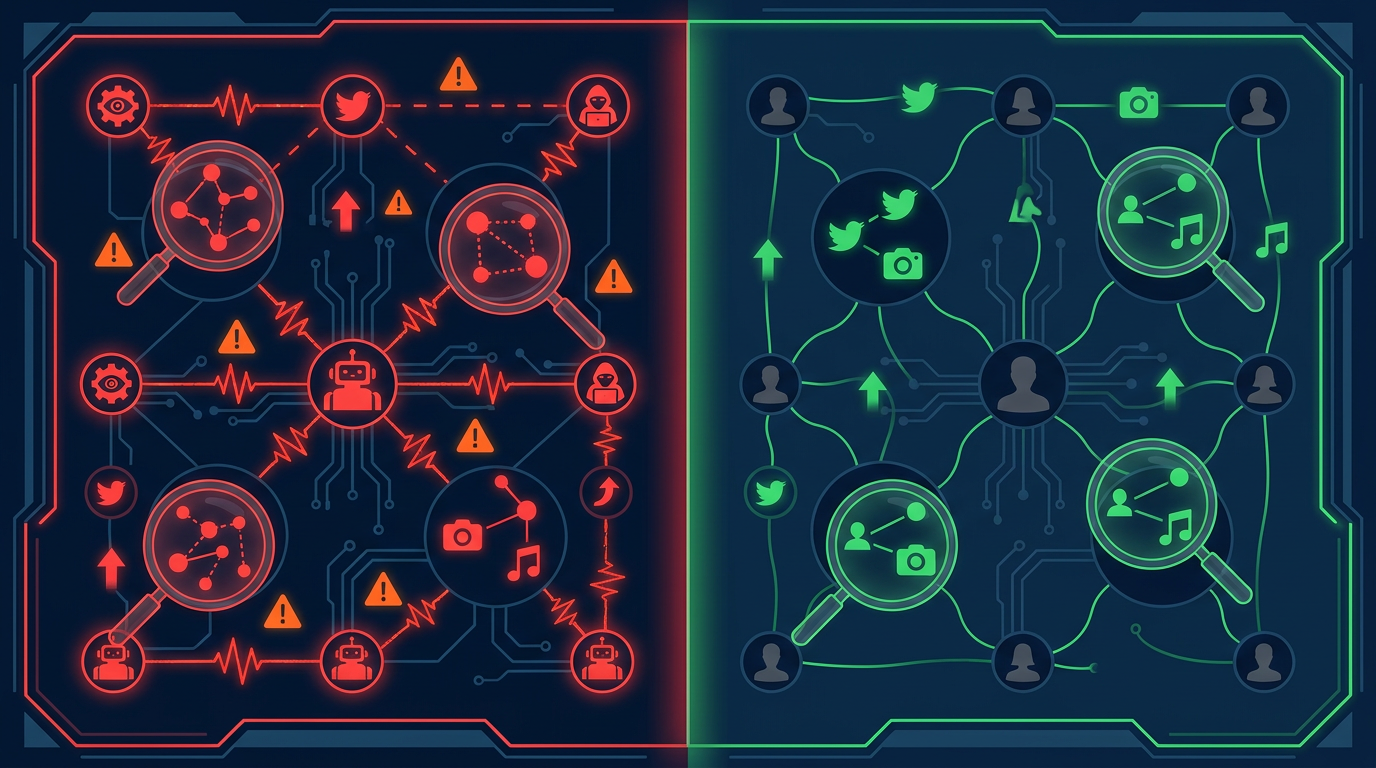
The signals that separate them are behavioural: near-identical text or media posted within minutes, clusters of accounts with similar creation dates, shared follower structures, and posting rhythms that ignore local time. The standard method builds a similarity network of accounts, runs community detection, and validates the densest clusters by hand before anything is called coordinated. Our companion guide, Detecting Coordinated Inauthentic Behavior: A Technical Guide, walks through that pipeline step by step.
Attribution is a separate step again. DFRLab's 2026 reporting on elections in Georgia, Moldova, Armenia and Azerbaijan documented how foreign and domestic actors intertwine in the same narratives, and its Armenian election work relied on infrastructure analysis (domains, hosting, channel networks) rather than content alone. Attribution claims need that evidence layer; narrative tracking does not, and should not imply it.
How Do You Preserve Evidence and Stay Within Ethical Limits?
Preserve at collection time. Store the post identifier, author identifier, timestamp, full text, media hashes, engagement figures at capture, and the query that found the post. Content gets deleted during campaigns, sometimes because platforms act on it, and a finding that cannot be re-examined is not a finding. Export to CSV or a database on the day of collection rather than relying on links.
Minimise what you keep about individuals. Election research is about narratives and networks, not private citizens, so aggregate where the analysis allows, drop personal fields you do not need, and apply a retention schedule. Most institutional review boards and the DSA vetted-researcher process expect a data management plan that says exactly this.
Publish the method with the findings. EDMO's Rapid Response System, which coordinated evidence-sharing across the spring 2026 elections in Hungary, Bulgaria, Cyprus and Malta, treats transparent methodology as part of election protection: readers can weigh a claim of narrative pressure only if they can see how the narrative was defined and sampled.
Where Does a Social Data Platform Fit in an Election Monitoring Stack?
For the campaign window itself, when the question is "what is spreading this week and where", a commercial data platform is usually the fastest route, because it removes the per-platform eligibility reviews and the per-read billing. xpoz indexes billions of public posts across Twitter/X, Instagram, TikTok and Reddit and exposes keyword, hashtag, sound, subreddit and user search with date and language filters through MCP, a REST API, SDKs and a CLI, so a narrative card's indicator set can be run on all four platforms in one pass and exported to CSV.
Two honest limits. xpoz is built for live-campaign monitoring and the weeks after the vote, and it does not publish a guaranteed archive depth, so multi-year archives remain the domain of platform research programs and academic datasets. And it returns public posts only; nothing behind private accounts or in closed groups.
Cost is predictable rather than per-read: credits are charged per query, with no charge for the number of rows returned. A Twitter/X or Reddit query costs 2 credits, TikTok 5 and Instagram 12. The Free tier is a one-time 500 credits; Pro is $20 a month for 7,500 credits; Max is $200 a month for 120,000 credits. Our guide to affordable social data for academic research compares the other options, and the historical Reddit data after Pushshift tutorial covers the archive side.
Key Takeaways
- Official researcher access in 2026 is non-commercial, reviewed, and slow: plan access before the campaign, not during it.
- Define narratives as claim families with neutral propositions and multilingual indicator sets, and update the sets weekly.
- Sample every platform with identical date windows and cadence, and report collection limits per platform.
- Measure volume over time, migration order, and engagement concentration; cross-platform replication is the norm, and it is predictable early.
- Keep three questions apart: is the claim true, is the amplification coordinated, and who is behind it. Each needs its own evidence.
- Preserve evidence on the day of collection, minimise personal data, and publish the method.
Frequently Asked Questions
How do researchers get social media data for election monitoring in 2026?
Through four routes: platform research programs (TikTok Research API and Meta Content Library, both limited to vetted non-commercial researchers with reviews that take weeks), pay-per-use platform APIs (the X API bills $0.005 per post read with no academic tier), the EU vetted-researcher pathway under the Digital Services Act, and commercial social data platforms such as xpoz that index public posts across Twitter/X, Instagram, TikTok, and Reddit and can be queried the same day.
What is a narrative in election monitoring?
A narrative is a recurring claim family, not a keyword: a set of statements that share a proposition (for example, that a ballot-counting process is unreliable) even when the wording, language, and platform change. Monitoring projects operationalise each narrative as a list of indicator phrases, hashtags, and multilingual variants, then count and date-stamp matching posts on every platform to measure spread.
How do you tell organic spread from coordinated amplification?
Organic spread shows diverse authors, staggered timing, and varied wording. Coordination shows near-identical text or media posted within minutes by accounts with similar creation dates, follower structures, or posting rhythms. Researchers build a similarity network of accounts, run community detection, and validate the densest clusters by hand before calling anything coordinated.
Can xpoz be used for election research?
Yes, for live-campaign monitoring. xpoz indexes historical and recent public posts across Twitter/X, Instagram, TikTok, and Reddit, with keyword and hashtag search, date and language filters, and CSV export. It suits tracking narratives during a campaign window; multi-year archives are better served by platform research programs or academic datasets.