
How to Find Leads on Social Media by Monitoring Buying-Intent Keywords
Finding leads on social media comes down to a three-step loop: pick the phrases that signal buying intent ("alternative to [competitor]", "recommend a tool for"), monitor Twitter/X and Reddit for posts matching them, and qualify what comes back before you reply. People announce purchase decisions in public every day. The loop catches them while the decision is still open.
This works because buyers ask strangers before they talk to vendors. Social Media Examiner's industry research found roughly two-thirds of marketers generate leads from about six hours a week of social effort, and 33% say social delivers their highest-quality leads. We built Xpoz for exactly this monitoring layer: keyword search over Twitter/X, Instagram, TikTok, and Reddit that an AI assistant can query and filter in plain English. The buying-intent loop below is the single most common workflow among its heaviest users.
Step 1: Build Your Buying-Intent Phrase List
Buying-intent keywords fall into five buckets. Seed each with your competitors' names and your category words:
| Bucket | Signal strength | Example phrases |
|---|---|---|
| Switching | Highest | "alternative to [competitor]", "switching from [competitor]", "leaving [competitor]", "[competitor] pricing increase" |
| Asking | High | "can anyone recommend", "looking for a tool that", "what do you use for", "best tool for [problem]" |
| Evaluating | High | "[competitor A] vs [competitor B]", "is [competitor] worth it", "anyone tried [competitor]" |
| Budgeting | Medium-high | "budget for", "worth paying for", "free alternative to" |
| Struggling | Medium | "we're struggling with [problem]", "frustrated with [competitor]", "[competitor] keeps [failing/breaking]" |
Two platform-specific adjustments matter, because the same intent reads differently on each network:
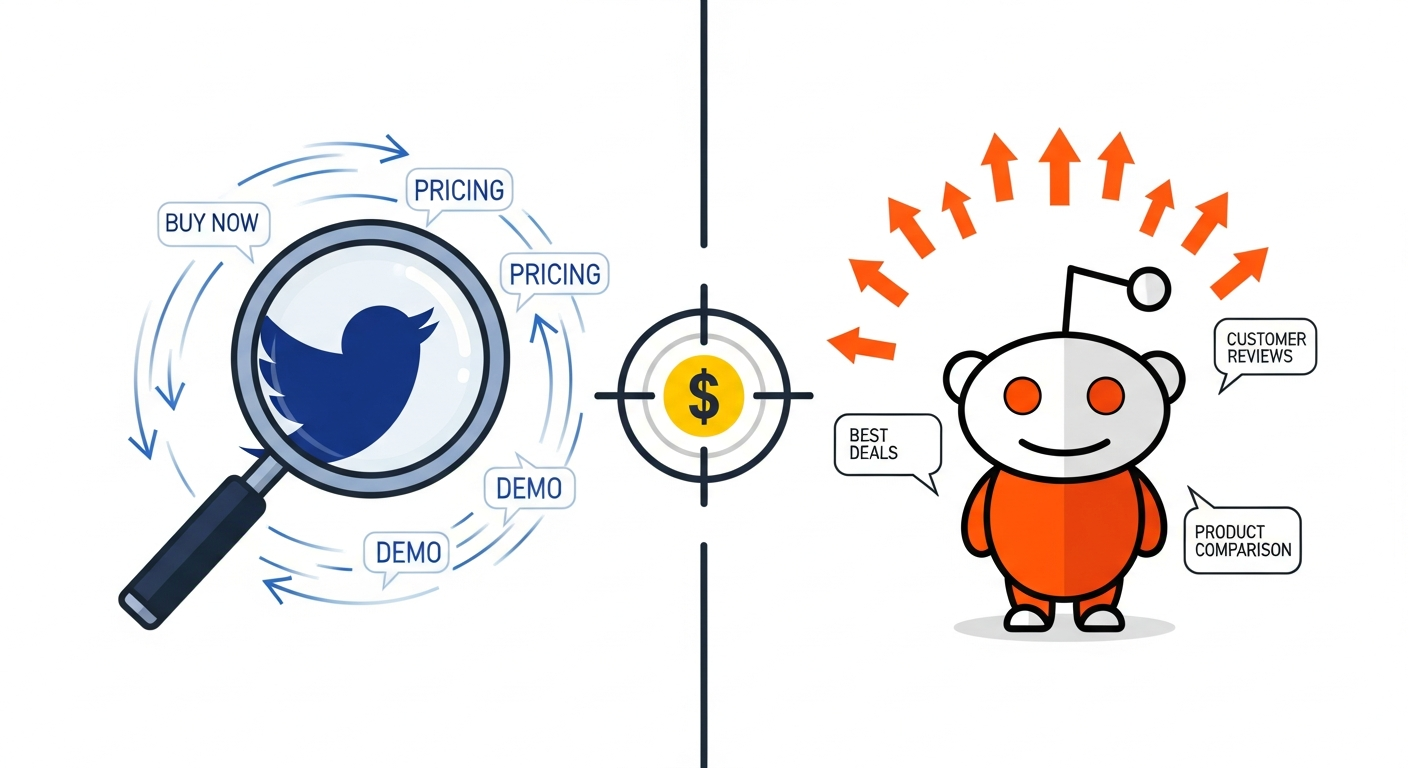
Reddit: people ask. Reddit buyers post explicit requests in niche subreddits: "Looking for a social listening tool under $100 for a two-person team. What should I try?" The phrasing to monitor is literally "looking for", "asking for", "recommend me", "what should I use" plus your category term. Searches shaped like "find Reddit posts where people are looking for [your category]" return threads where the author expects vendor suggestions, so answering is welcome, not intrusive.
Twitter/X: people complain. X buyers rarely ask; they vent at the moment of frustration: "[Competitor] just doubled our bill. Done." The phrases to monitor are competitor names next to "pricing", "bill", "support", "down again", "done with", "migrating off". A complaint plus a follow-up question in the replies is a switching signal.
Step 2: Run the Monitoring Loop
The loop is the same whether you run it by hand weekly or an agent runs it daily. With an AI assistant connected to Xpoz, each pass is one query:
"Search Twitter and Reddit for posts from the last 7 days matching:
'alternative to Brandwatch', 'alternative to Mention',
'looking for a social listening tool', 'recommend a brand
monitoring tool'. Exclude retweets and job postings. Show author,
date, engagement, and a link for each."
Three mechanics make the loop reliable:
- Fixed window, no gaps. Search "last 7 days" weekly or "last 24 hours" daily. Buying windows are short. A Reddit ask usually collects its recommendations within a day or two, so a monthly sweep mostly finds closed decisions.
- Track your standing terms. Put your competitor names and category phrases on continuous tracking (in Xpoz: tracked keywords) so coverage is deeper and fresher than one-off searches.
- Keep exclusions in the query. "Alternative to" also matches SEO listicles and job ads. Excluding links-only posts, retweets, and hiring language keeps the result set human.
The agent variant. Because the loop is a fixed prompt over a data connection, an AI agent can run it on a schedule end to end: search, filter, qualify, and deliver a shortlist to Slack or a CRM each morning. Among Xpoz's own user base this is the heaviest recurring workflow, with standing searches shaped like "find high-intent leads for [category]" and "find Reddit posts where people are asking for [tool type]" running as daily agent jobs.
Step 3: Qualify Before You Reply
Raw matches are not leads. Prospect-to-qualified conversion in most teams' funnels runs around 10%, and the qualification pass is where the ratio is won. Score each match on three axes:
- Intent vs. venting. A complaint with no question ("ugh, [competitor] is down again") is sentiment, not a lead. A complaint plus an open decision ("...seriously, what else is out there?") is a lead. The ask is the qualifier.
- Recency. A "looking for a tool" thread from last week is live; the same thread from last quarter is answered and closed. Weight the last 72 hours heavily.
- Author context. Check the profile before replying: a founder or team lead posting from a real account outranks an anonymous account with no history. Follower count matters less than whether the author plausibly owns the buying decision. Bio, posting history, and what they've engaged with tell you that in a 30-second check (or an agent's automatic pass).
Then reply where the conversation lives: answer the Reddit thread with a genuinely useful comparison, reply to the tweet with the specific fix. The DM comes after the public reply earns it. For a worked end-to-end example, see how one team turned social signals into 47 qualified leads in a week.
Try this with Xpoz
No API keys needed. Query Twitter, Reddit, Instagram & TikTok with natural language.
The Phrase List Is a Living Asset
Review the list monthly against what actually converted. Every new competitor pricing change spawns a switching wave (Mention's move to $599/month orphaned its self-serve tier, and "Mention alternative" became a live phrase overnight). Every lost deal names the phrase your buyer used before you found them; add it. Prune buckets that only return noise, and deepen the ones that convert with engagement-pattern analysis.
For always-on coverage of the subreddits where your buyers ask, pair the loop with subreddit-level monitoring.
Key Takeaways
- The loop is: phrases, monitor, qualify, reply. Everything else is tuning.
- Reddit asks, X complains. Monitor "looking for / recommend" phrasing on Reddit and competitor-name-plus-frustration phrasing on Twitter/X.
- Switching phrases are the highest-intent bucket. "Alternative to [competitor]" catches buyers mid-decision.
- Qualify on the ask, the clock, and the author. An open question, posted recently, by someone who owns the decision.
- Automate once it works manually. An AI agent with a social data connection (Xpoz from $20/month, free tier of roughly up to 75,000 results one-time) runs the identical loop daily without you.
Frequently Asked Questions
What are buying-intent keywords?
Buying-intent keywords are phrases people use publicly when they are close to a purchase decision: "alternative to [product]", "can anyone recommend a tool for", "we're switching from", "budget for", "is [product] worth it". They differ from general topic keywords because they signal an active buying process, not casual interest. Monitoring them on Twitter/X and Reddit surfaces prospects at the moment they're evaluating options.
How do I find potential customers on social media?
Run a three-step loop: pick 10-20 buying-intent phrases for your category ("alternative to [competitor]", "recommend a tool for [problem]"), monitor Twitter/X and Reddit for posts matching them, then qualify each match by recency, author context, and whether it states a real evaluation. With a data tool like Xpoz connected to an AI assistant, one query returns matching posts across platforms and the assistant does the first qualification pass.
Which social platform is best for finding leads?
It depends on where your buyers complain and ask. Reddit is strongest for explicit asks: people post "looking for a tool that does X" in niche subreddits expecting recommendations. Twitter/X is strongest for complaint-driven switching signals ("done with [competitor], what else is there?"). Social Media Examiner's research found about two-thirds of marketers generate leads from roughly six hours a week of social marketing.
Can AI agents monitor social media for leads automatically?
Yes. An AI agent connected to a social data source (for example Xpoz over MCP) can run the buying-intent loop on a schedule: search the phrase list across Twitter/X and Reddit, filter out venting and job posts, score what remains by recency and author context, and deliver a shortlist. This is one of the heaviest real-world workflows among Xpoz users, and teams run it daily as a standing lead feed.
Conclusion
Lead generation from social media is a monitoring discipline, not a content discipline. The buyers are already posting ("alternative to", "recommend a tool", "we're struggling with"), and the team that sees those posts within a day wins the reply.
Start manually: build the five-bucket phrase list, run the weekly query, reply to three qualified threads. When the manual loop produces leads, put it on a schedule. Xpoz's free tier (roughly up to 75,000 results, one-time, across Twitter/X, Instagram, TikTok, and Reddit) is enough to prove the loop before the $20/month tier takes over the daily schedule.